

 (310) 513-0618

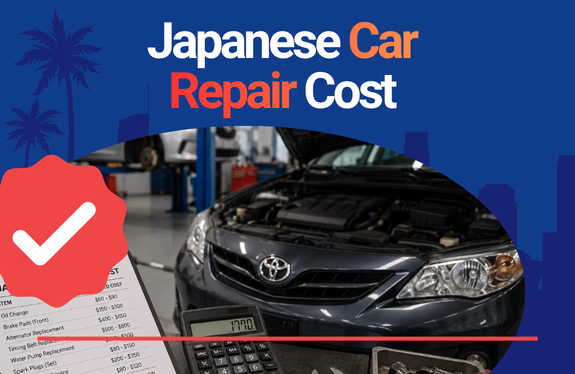
How Much Does It Cost to Repair a Japanese Car? – Cost Guide
Repairing a Japanese car costs $428 to $607 a year on average, because brands like Toyota, Honda, and Mazda use simple designs and widely...

 Mon-Fri 8:00am – 5:00pm • Sat 8am – 12pm • Sun Closed
 731 Pacific Coast Hwy, Harbor City, CA 90710


A pre-purchase inspection checklist for Japanese cars in Los Angeles covers six areas: documents and history, exterior and body, under the hood, interior, tires and brakes, and a cold start and test drive. It also adds model-specific checks, like CVT health, timing belt history, and hybrid battery condition, that a generic used car inspection checklist misses.

Table of Contents
ToggleWant a written estimate?
Photos and technician notes before any work is approved. Call (310) 513-0618

Download the Pre-Purchase Inspection Checklist for Japanese Cars
Two printable pages that work as a complete used car checklist. Take it with you to the seller.
Download the free checklist (PDF) 2 pages, 63 KB. No sign-up needed.Each area of the checklist needs a different level of skill. Use the table to see which checks you can do yourself at the seller and which ones need a mechanic with a lift and a scan tool.
| Area | What to Check | DIY or Mechanic |
|---|---|---|
| Documents and history | Title, smog certificate, recalls, service records | DIY |
| Exterior and body | Paint, panel gaps, structural damage, rust | DIY, lift for underbody |
| Under the hood | Fluids, leaks, OBD2 scan | DIY plus mechanic |
| Transmission | Shift quality, CVT behavior | Test drive plus mechanic |
| Hybrid system | Battery health, warning messages | Mechanic |
| Interior | Warning lights, A/C, flood signs, wear | DIY |
| Tires, brakes, and suspension | Tread, pads, shocks and struts | DIY |
| Cold start and test drive | Startup noises, brakes, freeway behavior | DIY |
Start with the paperwork, because a clean car with a bad title is still a bad buy. In California, the seller must provide a valid smog certificate for most cars more than four model years old. Run the VIN through NHTSA’s free recall lookup to catch open recalls, including the large airbag recalls that affected many Honda, Toyota, and Nissan models.
A car that recently failed smog may need smog check repairs before the seller can legally transfer it.
Inspect the car in direct daylight, where mismatched paint and wavy panels are easiest to spot. Look for overspray inside the door jambs and fuel door, and check the shock towers and radiator support for welds or bent metal. Southern California sun and coastal air also leave faded paint, cracked trim, and rust on cars kept near the beach.
Check the engine bay before the test drive, while the engine is still cold. Clean fluids and a clean scan say a lot about how the car was maintained.
Blu Automotive Repair & Maintenance has served LA drivers since 1997 with ASE Certified Mechanics, AAA approval, and expert care for Toyota, Lexus, Honda, and all Asian makes & models. Every repair is backed by a 2-year / 24k-mile warranty.
Call Us Today!

Many Japanese cars now use a CVT, including models from Nissan, Honda, Subaru, and Toyota. A healthy CVT pulls away smoothly and quietly. Whine, shudder, or a delay from a stop can point to an expensive transmission repair. Ask for records of fluid changes, since regular service matters for CVT life and can save you from weighing CVT transmission repair vs replacement later.
Hybrids are everywhere in LA, from the Prius to the RAV4 Hybrid. The READY light should come on with no warnings, and the car should switch smoothly between electric and gas power. On an older hybrid, the battery’s health matters more than the mileage.
Warning lights, weak A/C, and flood damage are the big three inside the car. LA summers make working A/C essential, and flood-damaged cars from other states can be resold here.
Tires and brakes tell you how the car was driven and maintained. Uneven tread often points to alignment or suspension problems.
Ask the seller not to start the car before you arrive. Listen for a short metallic rattle at startup, a known sign of a worn VVT-i gear on some Toyota engines or a timing chain tensioner on some 2000s Nissans. Then drive for at least 20 minutes on surface streets and the freeway, between 30 and 65 mph.
Each Japanese brand has a few known weak spots. These are the ones worth checking before you buy.
| Model or Engine | What to Check |
|---|---|
| Older Toyota and Honda V6 engines | Receipt for timing belt replacement |
| CVTs from Nissan, Honda, Subaru, and Toyota | Fluid change records and smooth takeoff |
| Some late-2000s Toyota 2.4L four-cylinders | Oil consumption between changes |
| Some 2000s Nissan engines | Timing chain rattle on cold start |
| Older Subaru 2.5L engines | Head gasket seepage and coolant loss |
| Prius and other hybrids | Hybrid battery test and catalytic converter present |
| Many 2000s Honda, Toyota, and Nissan models | Airbag recall completed |
A checklist catches the obvious problems, and a mechanic catches the rest. A lift shows the underbody, a scan tool finds stored fault codes, and experience spots each model’s known issues. At Blu Automotive Repair & Maintenance, our Japanese auto repair specialists inspect used cars for buyers across Los Angeles and the South Bay.
What a mechanic adds:
A pre-purchase inspection should include the paperwork, exterior and body, under the hood, interior, tires and brakes, and a cold start and test drive. For Japanese cars, add model-specific checks such as CVT behavior, timing belt history, and hybrid battery health. In California, also confirm the seller has a valid smog certificate.
The 30-60-90 rule for cars refers to major maintenance milestones at 30,000, 60,000, and 90,000 miles. Each step adds bigger services, such as new spark plugs and fluid changes, and on some older engines a timing belt. When buying a used Japanese car, ask for receipts showing these services were done on time.
The 3 year car rule in Japan refers to the shaken inspection, which new cars must pass after their first three years and every two years after that. Strict, costly shaken checks are one reason many Japanese cars are sold young with low miles. For a JDM import, ask for the shaken records, since they show past mileage and repairs.
The seller needs to provide a valid smog certificate when selling most cars in California. The smog check must be done within 90 days of the sale. Cars four model years old or newer are exempt, though the buyer pays a smog transfer fee instead.
An inspection checklist is still worth using on a low-mileage car. Low miles can hide age-related problems like dried-out seals, old tires, and a weak battery. Short trips in city traffic also wear brakes and transmissions faster than freeway miles.
A careful inspection takes about an hour and can save you thousands on a used Japanese car that looks better than it runs.
Want a professional pre-purchase inspection in Los Angeles? Schedule an appointment with Blu Automotive Repair & Maintenance in Harbor City or call (310) 513-0618.

Meet The Author:
Luis Imaicela
Luis Imaicela is the President of Blu Automotive Repair & Maintenance in Harbor City, CA. Having grown up in the family business founded in 1997, he now leads the shop with a strong focus on honesty, transparency, and high-quality repair work. Luis is dedicated to making the repair process less stressful by ensuring customers understand every step and feel confident in the care their vehicle receives.
Repairing a Japanese car costs $428 to $607 a year on average, because brands like Toyota, Honda, and Mazda use simple designs and widely...

The main Japanese car brands are Toyota, Honda, Nissan, Mazda, Subaru, Mitsubishi, and Suzuki. There are also three luxury names: Lexus, Acura, and Infiniti....

If you're wondering whether tariffs will affect Japanese cars in 2026, this guide breaks down what's actually happening, which Japanese cars are most affected,...
We use cookies to analyze our website traffic and measure our Facebook ads. You can manage your choices or opt out at any time.