

 (310) 513-0618

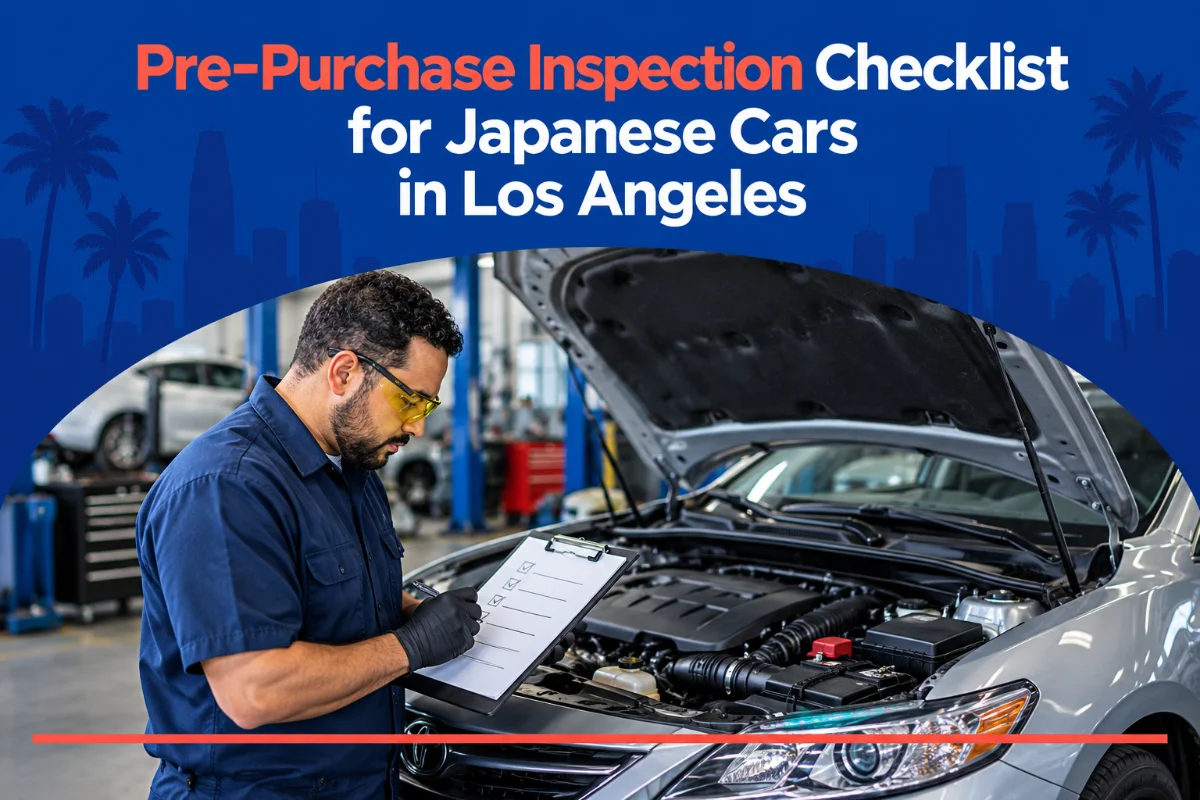
Pre-Purchase Inspection Checklist for Japanese Cars in Los Angeles
A pre-purchase inspection checklist for Japanese cars in Los Angeles covers six areas: documents and history, exterior and body, under the hood, interior, tires...

 Mon-Fri 8:00am – 5:00pm • Sat 8am – 12pm • Sun Closed
 731 Pacific Coast Hwy, Harbor City, CA 90710


Japanese cars are easier and cheaper to repair than American and European cars, thanks to simpler engineering, wider parts availability, and shorter labor times.

Table of Contents
ToggleWant a written estimate?
Photos and technician notes before any work is approved. Call (310) 513-0618Here is how Japanese, American, and European cars compare at the repair shop:
| Japanese | American | European | |
|---|---|---|---|
| Design & simplicity | Modular, proven engines kept in production for years | Rugged trucks and V8s next to complex crossovers | Dense, high-performance engineering with tight tolerances |
| Parts & costs | Affordable and widely stocked | Cheapest, deepest parts supply | Expensive, often imported |
| Reliability | Fewest unexpected failures | Moderate | Needs frequent, precise maintenance |
| Common issues | CV axles, struts, O2 sensors | Ignition coils, alternators, ball joints | Turbo parts, control arms, gaskets, electronic modules |
| Diagnostics | Generic scan tools cover most jobs | Brand software for some modules | Brand software for many jobs |
| Best shop | Japanese specialist | Almost any shop | European specialist |
Japanese automakers design for long life and easy servicing. Toyota and Honda keep proven engines and transmissions in production for years, so mechanics know them well. In the Japanese vs. European cars comparison, European brands chase performance and refinement, which brings turbochargers, direct injection, and more electronics. American cars sit in between, with simple trucks and V8s next to complex modern crossovers.
What this means at the shop:

Parts for Toyota, Honda, and Nissan are easy to find in the US because millions of these cars are on the road and many are built here. Quality OEM-equivalent parts keep prices fair. American cars have the deepest parts supply of all. European parts often come from the dealer or overseas, so a repair can wait days for one component.
Before any repair, ask your shop:
Blu Automotive Repair & Maintenance has served LA drivers since 1997 with ASE Certified Mechanics, AAA approval, and expert care for Toyota, Lexus, Honda, and all Asian makes & models. Every repair is backed by a 2-year / 24k-mile warranty.
Call Us Today!

Every car sold in the US since the 1996 model year has an OBD-II port, so a good scan tool reads basic check engine light codes on any make.

Japanese cars rarely need more for routine work. Many European repairs need factory-level software, and American trucks often need brand software for module programming.
| Job | Japanese | European |
|---|---|---|
| Battery replacement | Swap and go on most models | Often needs coding or registration, such as on BMWs |
| Fasteners | Standard metric bolts | Torx and triple-square bits common on German cars like VW and Audi |
| Deeper engine faults | Generic scan tool on most jobs | Brand software for many faults |
Japanese cars use standard fluids, usually low-viscosity oil like 0W-20 plus the maker’s own coolant and transmission fluid. Many European engines need oil with a specific maker approval, such as VW 504.00 or BMW Longlife-01. The wrong oil can harm the engine and complicate warranty claims, so even an oil change works differently.
Japanese cars have the fewest unexpected failures, so most visits are for normal wear items. American cars sit in the middle. European cars need frequent, precise maintenance to stay reliable. Before any repair, check for open recalls by VIN, since the dealer fixes some known issues for free.
| Origin | Typical Wear Items | Known Issues on Some Models |
|---|---|---|
| Japanese | CV axles, struts, O2 sensors | CVT wear on some Nissans, oil consumption on some older Toyota four-cylinders, timing belt service on older V6 engines |
| American | Ignition coils, alternators, ball joints | Cam phaser wear on some Ford V8s, lifter failures on some GM V8s with cylinder deactivation |
| European | Control arms, turbo parts, electronic modules | Coolant leaks from plastic cooling parts on BMWs, gasket oil leaks, carbon buildup on direct-injection engines |
Japanese cars usually need fewer repairs and less labor per job, so ownership costs stay low. European car maintenance cost is the highest of the three because of parts prices, special tools, and longer labor times. Japanese cars cost about $428 to $607 a year to maintain. American cars have cheaper parts, but often cost more to repair over time.

The right shop depends on where your car comes from. A specialist cuts diagnosis time because it has seen your fault many times before.
Blu Automotive Repair & Maintenance specializes in Japanese cars like Toyota, Lexus, and Honda, and we also service BMW models.
Japanese cars are easier to fix than most American and European cars. They use widely available parts, standard fluids, and generic scan tools for most jobs. Proven engines stay in production for years, so mechanics know them well. Most repairs are routine wear items like CV axles, struts, and O2 sensors.
The key differences between European and Japanese cars are engineering focus, parts supply, and maintenance needs. European cars prioritize performance, with turbocharged engines, dense electronics, and oils that need maker approvals. Japanese cars prioritize durability and simple servicing. As a result, European cars usually cost more to maintain and need a specialist with factory software.
European car maintenance cost is high because parts often come from overseas, oils must meet maker approvals, and many jobs need brand software. Tight engine bays also add labor time. Turbocharged direct-injection engines bring extra parts to service, such as high-pressure fuel pumps.
Most mechanics can handle basic work on a Japanese car, such as brakes and oil changes. For diagnosis, hybrid systems, or engine and transmission repairs, a Japanese specialist is faster and more accurate. Specialists know each model’s common faults and where to source the right parts.
Where your car comes from shapes almost every part of the repair, from the parts on the shelf to the tools in the bay.
Need Japanese car repair from mechanics who know these differences? Schedule an appointment with Blu Automotive Repair & Maintenance in Harbor City or call (310) 513-0618.

Meet The Author:
Luis Imaicela
Luis Imaicela is the President of Blu Automotive Repair & Maintenance in Harbor City, CA. Having grown up in the family business founded in 1997, he now leads the shop with a strong focus on honesty, transparency, and high-quality repair work. Luis is dedicated to making the repair process less stressful by ensuring customers understand every step and feel confident in the care their vehicle receives.
A pre-purchase inspection checklist for Japanese cars in Los Angeles covers six areas: documents and history, exterior and body, under the hood, interior, tires...

Yes, you can register a Japanese car in California, but it must be at least 25 years old and pass strict CARB emissions rules....

American car parts are usually cheaper and easier to find, but Japanese cars typically cost less to repair and maintain overall. The reason comes...
We use cookies to analyze our website traffic and measure our Facebook ads. You can manage your choices or opt out at any time.